Tile Forge
A tile editor with terrain and object layers, a map preview, validation and a playable Sokoban test. The tools belong beside the map, and play mode gives the board the available room.
Run it
Build the examples with devenv shell -- lcom-ng-build, then run:
lcom-ng run -- build/examples/tilemap_editor build/tilemap-demo.mlmapTry a complete workflow
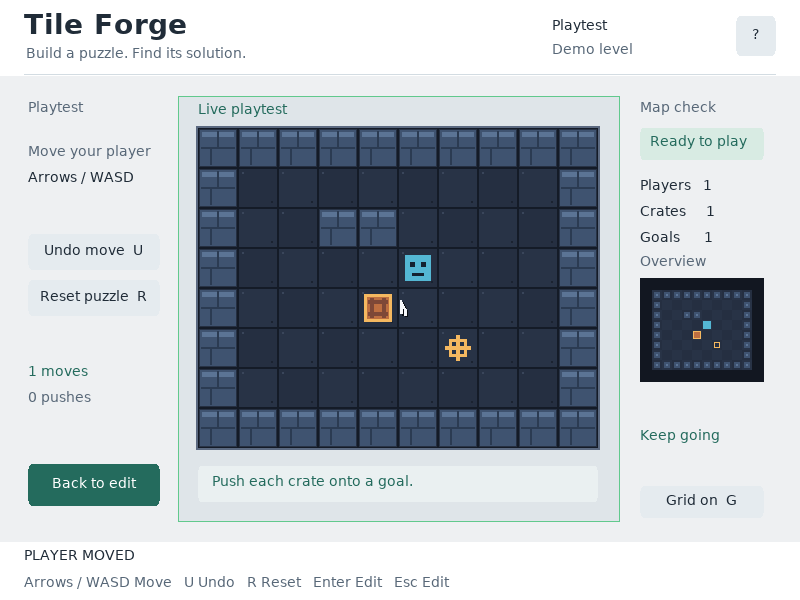
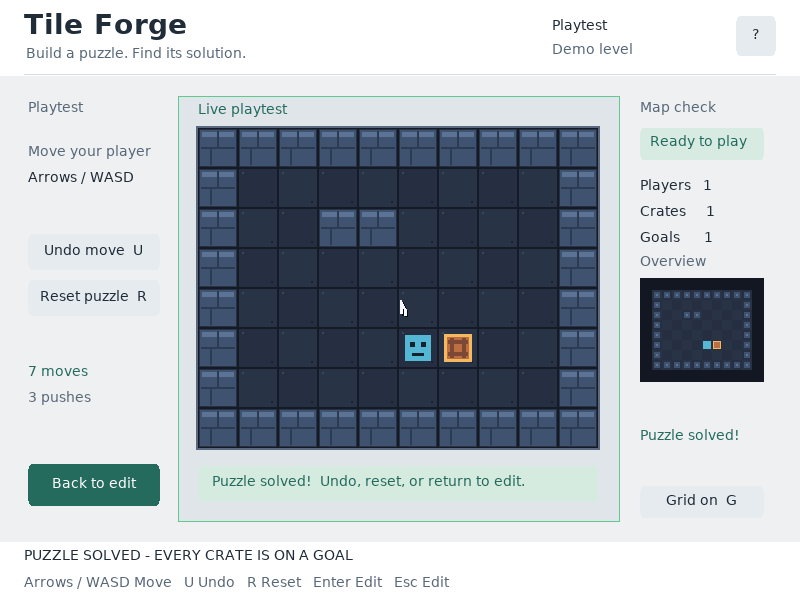
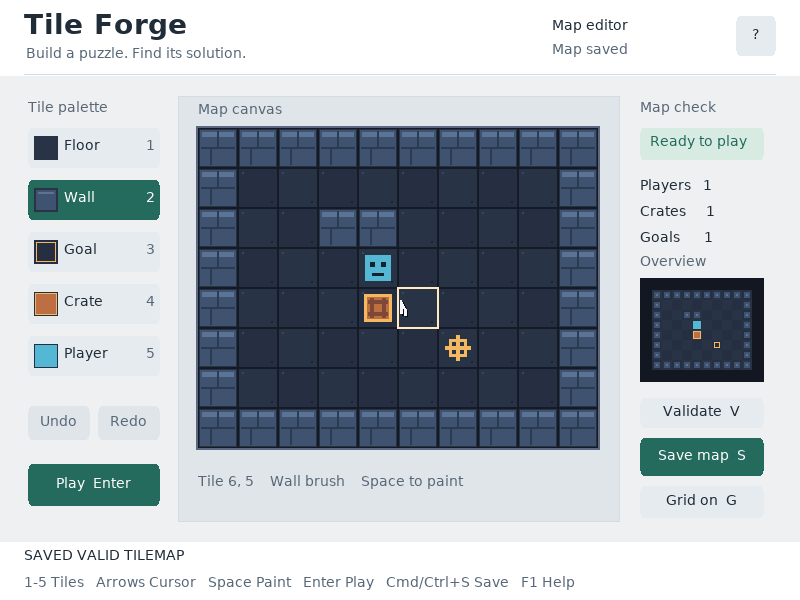
Paint walls, floors and goals, then place the player and crates. Validate the map, enter a playtest and solve it. Return to editing with Escape and save the map for a later session.
Controls
| Control | Action |
|---|---|
| 1-5 | Floor / wall / goal / crate / player |
| Mouse drag / right-click | Paint / pick tile |
| Arrows + Space | Move tile cursor and paint |
| Delete | Erase the tile under the cursor |
| Enter / F5 | Switch editor / playtest |
| Arrows / WASD in playtest | Move player |
| U / R in playtest | Undo move / reset puzzle |
| Cmd/Ctrl+Z / Shift+Z | Undo / redo map edit |
| V / G | Validate / toggle grid |
| Cmd/Ctrl+S / S / F2 | Save map |
| Esc in playtest | Return to editor |
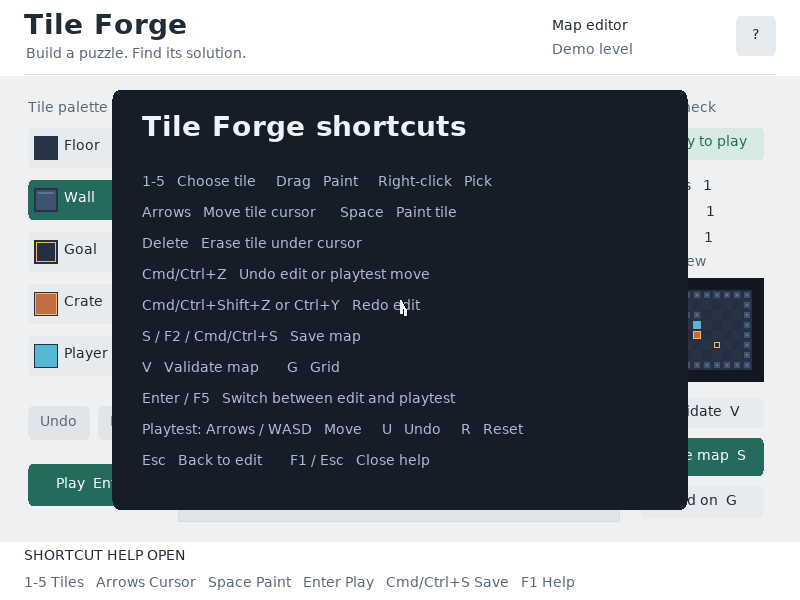
| F1 / ? button | Shortcuts |
Command shortcuts work on macOS; Ctrl shortcuts work on other hosts. Esc closes help first. Cmd/Ctrl+W closes the app.
In the app
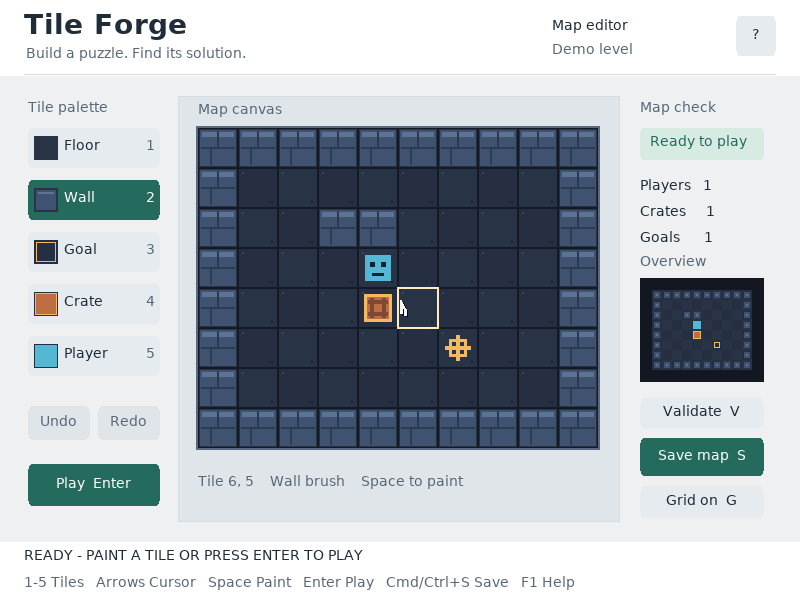
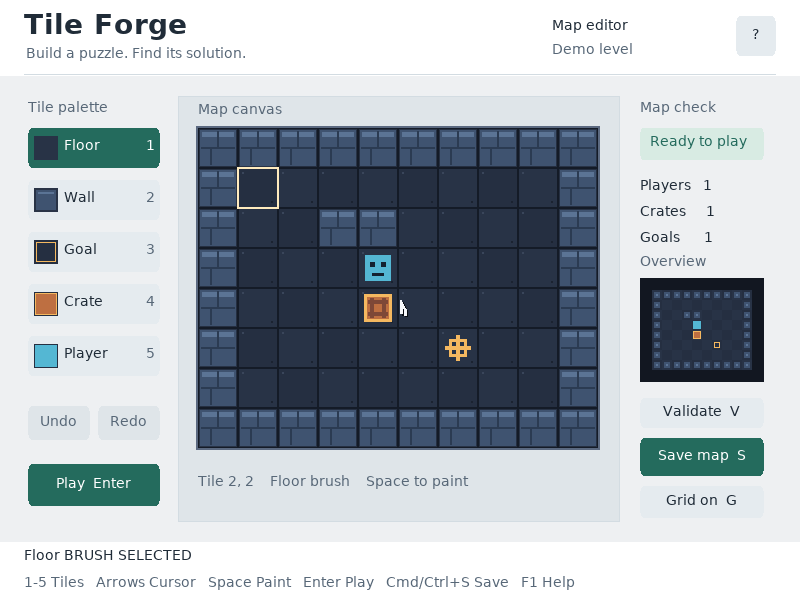
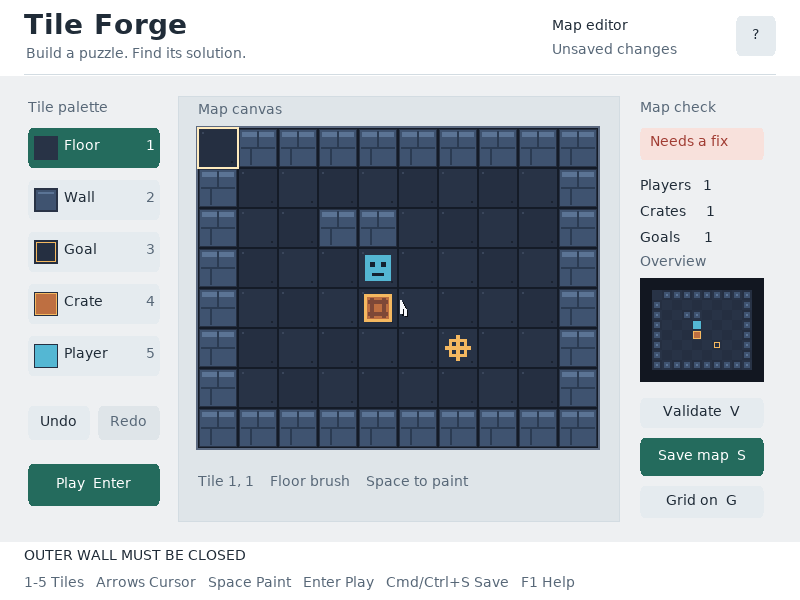
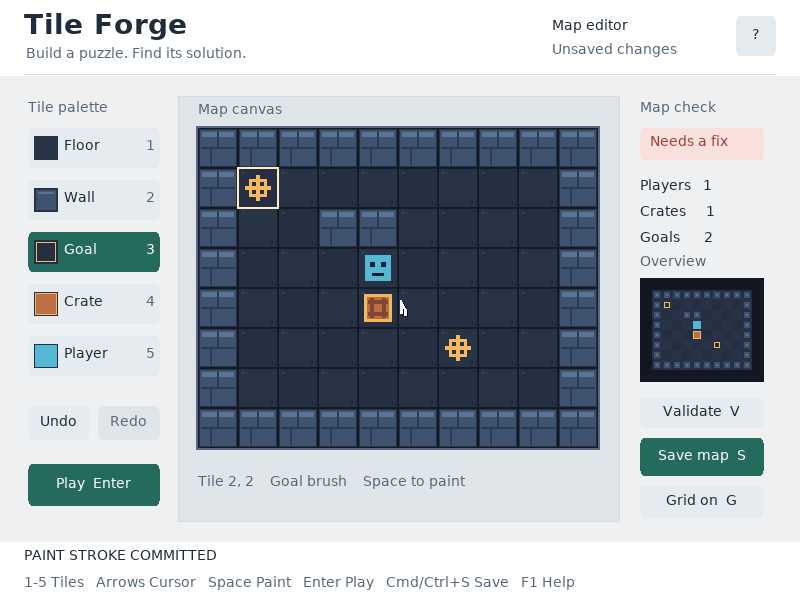
These are actual runtime captures. Open a screenshot for a larger view; use Left and Right to browse, and Escape to close.
What it demonstrates
Layered editing, map invariants, bounded parsing and serialization, keyboard movement and a separate playtest state.
A playable map needs a single player, matching crates and goals, and accessible puzzle space. Invalid drafts can be saved and corrected.
Source: examples/tilemap_editor.c.
Refresh these screenshots
devenv shell -- python3 scripts/capture_gallery.py --app tilemap-editorSee the screenshot workflow to add states or check freshness.